

Co-Creation Project Reflection- The Review of Education for Good and how we create the campaign.
Updated: Apr 8, 2022
Subject: Research and communication
Topic: Co- Creation Project Reflection
Student: Wong Chi Fai (Marcus)


Stage 1:What ?
1. The co creation project
Project brief:
Sender: Mayer
Receiver: Me, classmates
Messages(Project Brief): The Co-Creation Project is a group project, with team members to select or create a company of Social Enterprise or Benefit Corporation(B Corp) to build their brand awareness, with featuring activity to enhance the performance in the target market.
This project aims of developing your profession in problem-solving, project management, organization, and interpersonal communication, also demonstrating your competence and understanding in the research and analysis, communication, and strategic thinking on the project.Introduce a b-corp. / social enterprise and examine the brand awareness and presence.
To see whether it can solve the pain points of the target segment and customers. How to improve the brand in the future.
Response: After the first meeting, we choose Education For Good (EFG) as our target to be examined.
Feelings:
Why EFG ?
1. EFG is an institute which focus on creative thinking and social innovation. As we are also learning this in the course, we are interested to know how it works and what they can provide to the customers/ consumers.
2. We had several choices, but others are hard to find data and not quite related to our interests. After discussion, my group agreed to work on this brand.
Why not a new brand?
1. We don’t have a strong common interest on specific social problems at this stage, so we agreed to examine an existing brand first.
2. Even though we are not doing a project to start a new brand, this project is still useful because we can use it as a test to know how to use all the strategies from lessons to apply in real world and this can facilitate our strategies for planning our own business later.
What is Co-creation project?
Definition: “Co-creation is the process by which mutual value is expanded together, where value to participating individuals is a function of their experiences, both their engagement experiences on the platform, and productive and meaningful human experiences that result” (Ramaswamy, 2011).
In our study, we use co-creation as a strategy for project management.
Our Plan:
We first study the basic information of the brand and set different parts that need to be discussed in our presentation. Therefore, we divided our work according to the parts that we set. The details are as the followings:
1. Marcus (me) :
Target segment and the pain points of the customers.
How do they target their segment and who are the target customers?
What solutions they are providing? Is that work?
What are the actual needs of the target customers?
The persona and empathy map may help?
2. Chi:
Define and explain what EFG is
How it related to B corp and social enterprise.
What are the definition of B corp and social enterprise?
Overview of the brand
Rearrange the slides and the summary of the campaign
3. Eowyn & Evan:
The journey map of the customers, arrange the interview
Find the competitors and compare them with EFG
Who are the competitors? What are their strengths?
What is the difference? (Design, website, social media, etc.)
Is EFG better than their competitors?
4. All group members: (common part than must be done together)
Find a good solution for EFG to use- the campaign
What kind of campaign?
Why EFG need this campaign?
When and how to implement the campaign?
Who can be benefited from this campaign?
How this solve the pain points of target audience and EFG itself?
2. How does this connect to my study in the course?
Here I need to clarify what is the objective of my study.
Simply speaking is research and communication.
1. Research
To develop the ability in research methodologies, analytical and critical thinking for communication with different manners in the area of Design, Innovation and Brand Management.
Focused on the blend of academic and pragmatic research
Record the research approaches, perspectives and theories through learning journals
2. Communication
Express think points on the presentation, debates, group discussion and reflective writing to evidence the study in a unit.
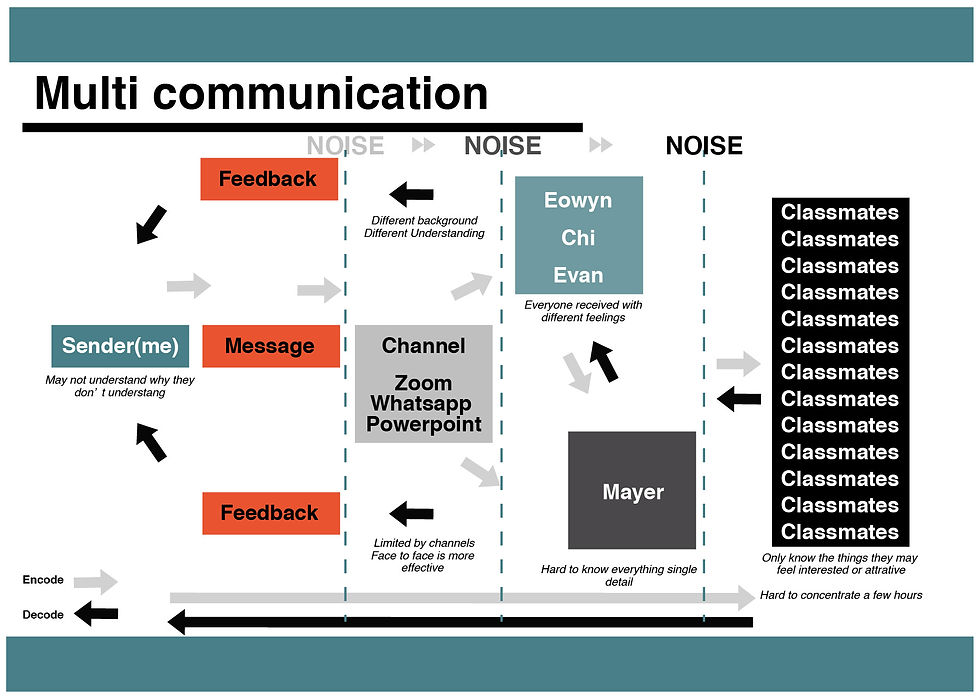
Because we need to consolidate all the learning outcome in 1 co-creation project. We need to research for the above questions and use a proper manner to carry out the messages to our audience. Besides, we need to learn how to communicate with different background’s classmate. To me, there are 3 communications in this project.
1. My group
2. Mayer
3. Other classmates
*Source: (Barnlund, 1970)
(Jacobs, 2016)
As shown in the illustration, this is a multi communication so we need have meetings and presentation regularly to reduces noises.
Stage 2: So What?
3: The important insight

*Source: (Traore, 2019)
1. The first thing I found the most important is how to carry out strategic proposal for a brand. (CONEXT)
The first time to combine all the learning in one. Including but not limited to research methodologies and methods, data analysis, brand audit, segmentation, targeting, positioning, social mining and text analytics, consumer behavior and attitudes, branding challenges and opportunities.
Not easy to handle all part by one person in such short time. So, cooperation is the key to make a success for this project. That's why we need to use co-creation as a method to do it.
We set the role of each member from the very beginning, and this worked very well.
However, noises can not easily be eliminated because not everyone have the same understanding in the course and so what we can do is the more the communication the lesser the noises will occurred.
Although finally we had made some mistakes on customer brand based equity pyramid and the campaign, overall the result is satisfying.
2. The second important insight come with the power of research.(DATA)
This is quite important as my main role is doing the research for group members to understand. For example, the segmentation of EFG and how they target their customers. As EFG is not a big brand, the information is quite limited, even the customers are lesser than my expectation. So I need to find many different kind of reports, statistics, interviews and even attend the lesson to know more about the motivation, the pain points and the point of difference/parity of EFG.
Also, with the help of my team members, I also learned how to analysis through the analysis of social media because I am not familiar with it although I had decided to learn it more deeply later.
3. Last but not least, how to motivate a team effectively is also learned in this project. (ACTION)
The is our first co-creation project and every team member has different background. No everyone of us are interested in this brand and the project. So, it is inevitable that not everyone can learn similarly in the project. The most difficult part is even we had meetings twice a week to reduce noises, but this could not ensure everyone was really participate in it so the messages being discussed may not effectively be encoded and decoded.
But I found that if everyone can report briefly and tell what he/she wants is a better way to communicate as this can ensure the two way communication is working. Furthermore, as we have different backgrounds, we can use our strength to contribute to the project. For example, Eowyn knew a lot of knowledges about marketing and data analysis, with her good English skills, she helped a lot when we were doing the project.
INSIGHT: RIGHT DATA + STRTEGIC PROPOSALS + EFFECTIVE TEAM WORK
= GOOD CO-CREATION PROJECT
4. How to develop and enhance learning through this project?

1. Better brand management with the use of data
With the data research skills, I can learn more on how to promote and conclude the proposal by data driven approach. As designers always relied on his/her subjective feeling to design things, the management skills are usually lacked. But with the data driven techniques, I can develop a design proposal or decision making through data driven approach which is based on objective data.
For example, before we set the target to 20-29 's students, i am thinking about that we should focus more on 30-39 (Co-creation Project Powerpoint p.48) . Because i found some of the research showed that most of the founders in the area of startup are in this age range. However, with more and more data received, i got more information that the actual reality is that there are more target audience in 20-29 rather than 30-39. (Co-creation Project Powerpoint p.51) One more important thing is that as a training institute, EFG didn't show enough effort to cooperate with universities to promote the concept of social enterprise and actually they are the new forces to start social enterprise and fit the vision of the EFG that education is the most important way to facilitate changes.
Promotes transparency and accountability
One of the main advantages of data driven process is that this can improve the transparency and accountability of decision making and so as to improve teamwork and therefore this is a good practice in brand management.
In addition, data-driven research may help in identifying trends before the market catches on to it. Companies can use the result to keep running their business for a long-term future.
(HARAPPA, 2020)
2. Design a strategic plan for a company
This is my first time to work for a strategic plan of a company. I found that the main problem of EFG is lied on the attitude of the customers. This is not the only problems of EFG but as I was focused on relieving the pain points and found the target customers I was mostly work on this part.
Generally, apart from the one who don’t know EFG, for those who already know EFG, most of the feeling are regarding them as providing training workshops but don’t know what can really do with their workshops which introduced creative thinking. Besides the support to people want to start up is unclear. I have watched the videos and browse the news and the comments on Facebook, but there are different messages I got.
1. The founder: Want to promote B CORP and Social Enterprise and help more people to start-up.
2. The news about EFG: Quite less and most were old news. But I can still know the basic information of it: A company related to Social Enterprise and have workshops.
3. The comments in Facebook: Positive about the event or the course, however, hardly to find any responses within 10 years. Most of the posts ‘response is 0-1.
4. The website: As a potential customer, I would like to join some course of creative thinking and about start-up, but I can only find most of them are workshops. Our team had also joined one of the online course of creative thinking and the feel is like I was learning from a youth centre, in other words, mainly for interest and hobby. I was not convinced that the courses are useful in daily life. Although you can find some comments of the people in big company who shared their views but that part may related to consultation’s area and the details of them are limited.
So EFG merely be though as an institution which providing some interest class of workshops for social innovation and creative thinking, as a result, their audience base cannot grow too much in this 10 years and the people who want to use start-up as a tool to solve social problems is not being rightly targeted. There is a gap between their imagery and feeling.

*Source: (The Mind Tools Content Team, s.d.)
After the review, the first thing we can do is to design a strategy/campaign to change the attitude of the customers first. And this part, I mainly inspired by using the strategies of attitude change to think about how to improve EFG.
The strategies of attitude change
These strategies are very useful if we want to reposition the brand image of the brand. It contains mainly six strategies (Fabian, 2013) and I used most of the strategies below(except number 5) when designing the campaign.
1. Changing the basic motivational function.
2. Associating the attitude object with a specific group or event.
3. Relating the attitude object to conflicting attitudes.
4. Altering components of the multi-attribute model.
5. Changing beliefs about competitors’ brands.
6. The elaboration likelihood model.
*Source: Co-creation Project Powerpoint p.63
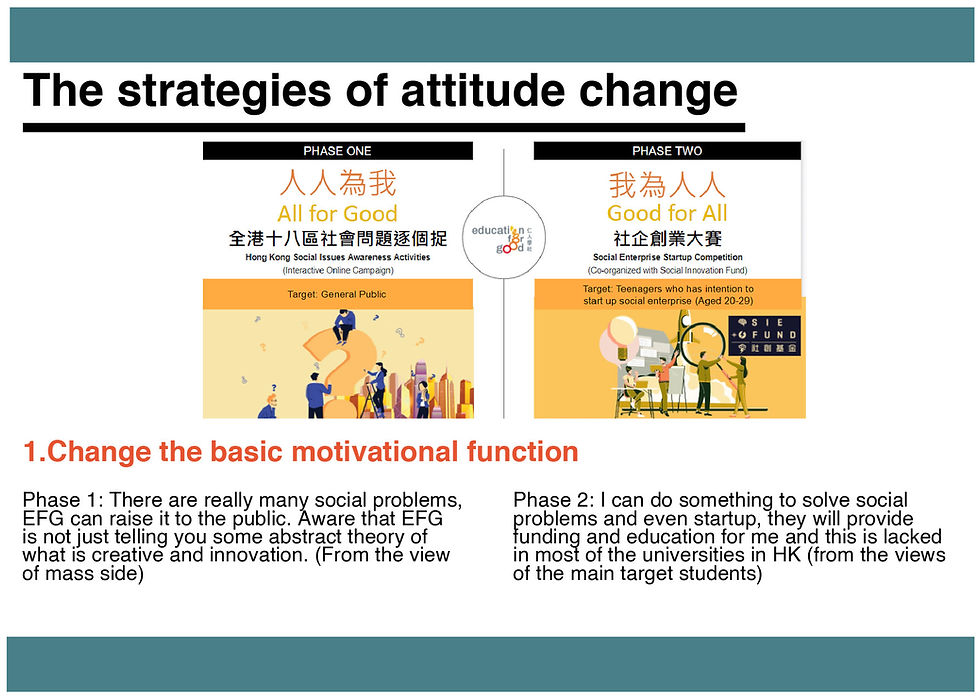
1. Change the basic motivational function
The utilitarian function is the way of changing attitudes in favor of a product is by showing people that it can serve a utilitarian purpose that they may not have considered. EFG as regraded a merely workshop providers, the utilitarian purpose of it is not so understandable by the mass.
Phase 1: There are really many social problems, EFG can raise it. Aware that the institute is not just telling you some abstract theory of what is creative and innovation. (from the view of mass side) Phase 2: I can do something to solve social problems and even startup, they will provide funding and education for me and this is lacked in most of the universities in HK (from the view of the main target students )
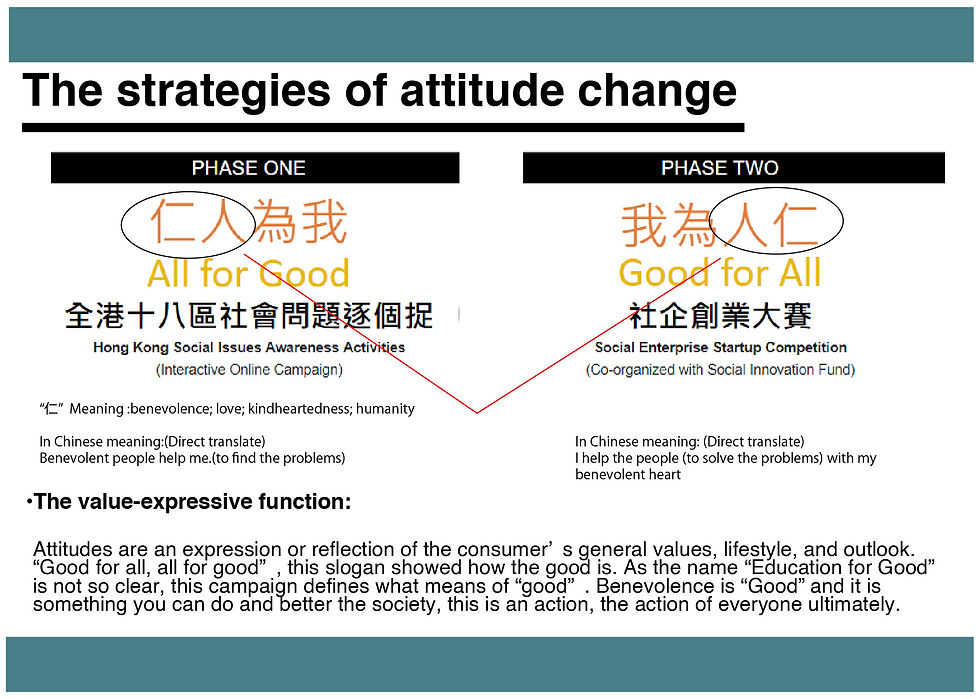
*Source: Amendment on Co-creation Project Powerpoint p.63. Although in chinese"人人" and "仁人" have the same pronunciation, but the meaning is different. The previous one means every people while the latter one means good people/ benevolent people. I use "仁人" here because it fits the chinese name of EFG and the meaning can be explained more deeply. I didn't amend it in the presentation because i don't have enough time to consider all the details so i wrote it down here to further explain the details as a suggestion.
The value-expressive function: Attitudes are an expression or reflection of the consumer’s general values, lifestyle, and outlook. “Good for all, all for good”, this slogan showed how the good is. As the name “Education for Good” is not so clear, this campaign defines what means of “good”. “Good” is something you can do and better the society, this is an action, the action of everyone ultimately.
*Source: Co-creation Project Powerpoint p.68.75)
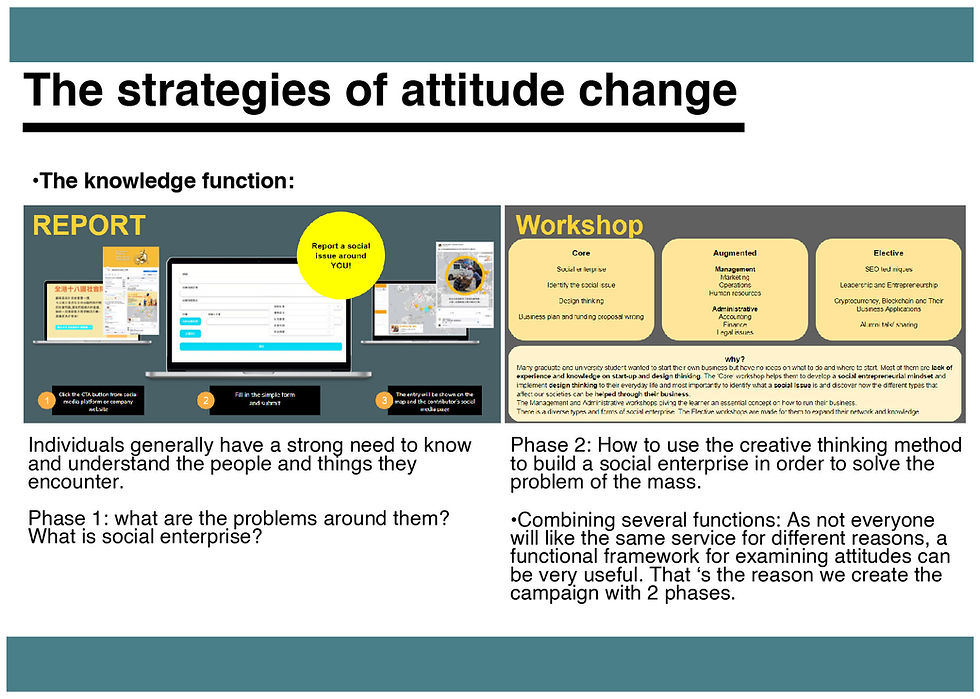
The knowledge function: Individuals generally have a strong need to know and understand the people and things they encounter. Phase 1: What are the problems around them? What is social enterprise? Phase 2: How to use the creative thinking method to build a social enterprise in order to solve the problem of the mass.
Combining several functions: As not everyone will like the same service for different reasons, a functional framework for examining attitudes can be very useful. That ‘s the reason we create the campaign with 2 phases.
*Source: Co-creation Project Powerpoint p.77-84)
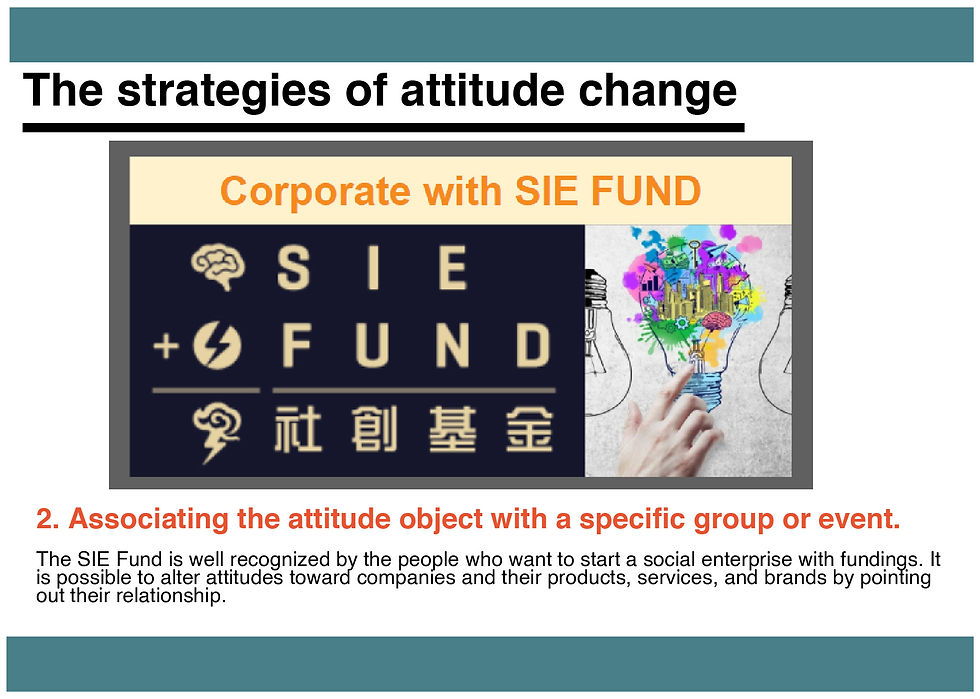
2. Associating the attitude object with a specific group or event.
The SIE Fund is well recognized by the people who want to startup a social enterprise with fundings. It is possible to alter attitudes toward companies and their products, services, and brands by pointing out their relationship.
Then, everyone can know clearer the aim of Education for good is to help people to startup a social enterprise and they can work to the aim with actual funding but not theory only.
*Source: Co-creation Project Powerpoint p.69)
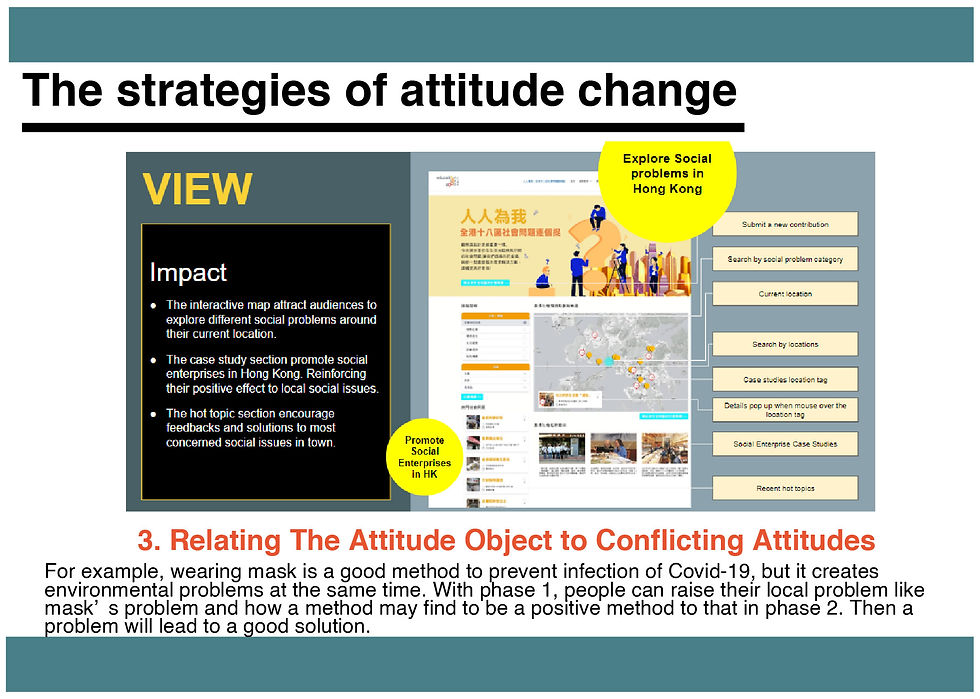
3. Relating The Attitude Object to Conflicting Attitudes
This is to resolve the actual or potential conflict between two attitudes or moving from negative to positive perception. And this is one of the main reason that we designed phase 1 to show the social problems where the perception of the problems should be negative.
For example, wearing mask is good method to prevent infection of Covid-19, but it created environmental problems at the same time. With phase, people can raise their local problem like mask’s problem and how a solution may found positive to that.
*Source: Co-creation Project Powerpoint p.85)
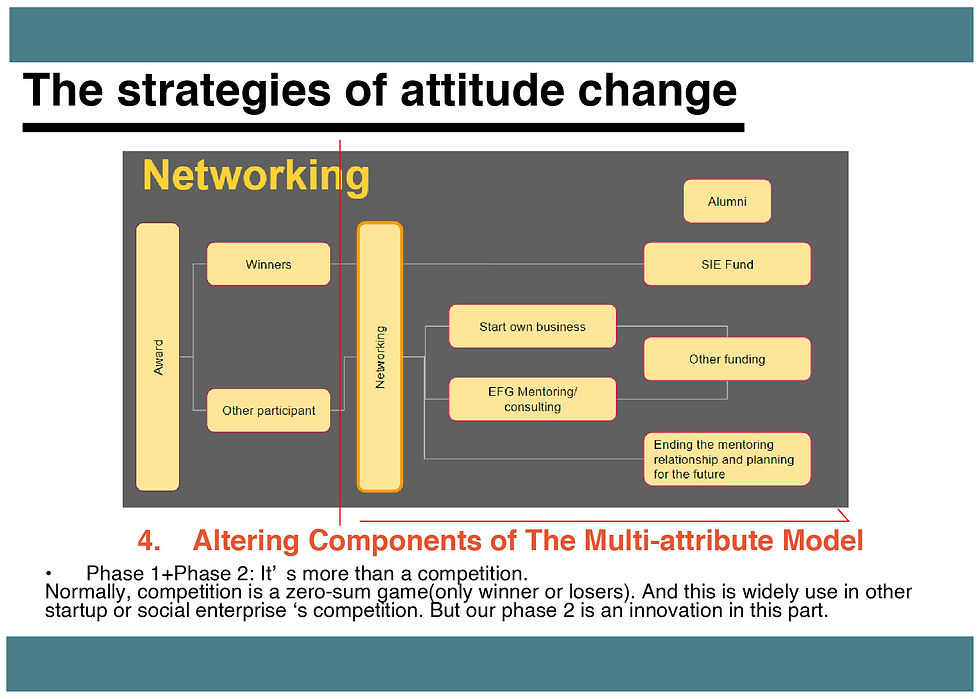
4. Altering Components of The Multi-attribute Model
Adding an attribute: This can be accomplished either by adding an attribute that previously has been ignored or one that represents an improvement or technological innovation.
Phase 1 + Phase 2: It’s more than a competition. Normally, competition is a zero-sum game. (footnote). And, this is widely use in other startup or social enterprise ‘s competition. But our phase 2 is an innovation in this part. Even the loser’s can continuouly to participate afterward with support. It is true that it is impossible for every participant to get the funding, but with the support, they can still find other ways. We don’t want to judge a winner and loser by this, as good is for the society not for one team/ one person.
5. Changing beliefs about competitors’ brands.
I didn’t use this strategy as I didn’t see their competitors like the Good Lab had a strong customer base even the compared result showed that they are little bit better than EFG on the visual design or the brand awareness. Therefore, even I compared to it, most of the target customers will not think much difference and finally I reviewed the Good Lab again, they are changing to focus on providing consultation for Social Enterprise so the actual competition become meaningless unless we are also changing to focus more on consultation’s area.

*Source: (aconsumingblog, 2016)
6. The elaboration likelihood model
Consumer attitudes are changed by two distinctly different routes to persuasion: The central information processing route and the peripheral route.
Here, the interesting thing is this campaign actually combined both in different stages.
Phase 1: Want to introduce SE and social problems to the mass, so it is low-involvement processing. In this stage, we don’t require a high level of thought process, simply find, capture, share and throw for discussion on the platform.
Phase 2: The central route to persuasion is directed at highly involved consumers, where persuasion will likely occur from a person’s careful thoughts and consideration. As the competition will use the top 10 problems from the phase 1( our presentation may have communication noises that we split it into 2 different campaign without linkage but that’s not the case) , it requires high levels of elaboration where cognitive thought processes and rational thought processing need to be used by the participates before they chose to join the campaign. It helps to shape a consumers’ attitude towards EFG. EFG is not just a company providing interest classes but doing something related to you and me. The campaign, therefore, shapes attitudes towards EFG.
After they successfully joined, they may find no matter the winner or the losers will have practical practices to work on solving the problems with fundings or teamwork. Even some of them may not be successful to startup, they can still join Social Enterprise first and as they are young, they still have times to fail and try before they success. Young is the most important capital for people to learn trial and error apart from money. Time is money. Funding is just a supplement for this.

Brand Revitalization strategies
I also reference to Brand Revitalization strategies to better expand the brand awareness of EFG.
It is very important for a company to know, what marketing or managerial actions possibly will revitalize the brand in the minds of the consumer.
The main key to revive a brand is to increase its differentiation. To support the revival, there must be well planned advertising and promotional campaigns.(UKESSAYS,2021)
How to carry out?

*Source: (Pearson Education, 2013)
According to the Brand Revitaliztion Strategies framework, there are 2 approaches.
1. Expand the depth or breadth (or both) of brand awareness by improving brand recall and recognition by consumers during purchase or consumption settings.
2. Improve the strength, favorability, and uniqueness of brand associations making up the brand image. related to this.
For EFG ‘s campaign, we mainly focus on the first approach.
With a fading brand, the consumers tend to think of the brand in very narrow ways and in the case of EFG, they merely be regarded as a training institute that provide interest classes of creative thinking workshops. Then, EFG should consider strategies to increase usage of and find new uses for the brand.
This approach represents the path of least resistance because it does not require difficult and costly changes in the brand image or positioning. As we found that EFT’s usage is very limited to those who already know and want to develop social innovation through the ways of joining workshops.

*Source: (Co-creation Project Powerpoint p.70)
Here are the next 2 steps:
1. Increase usage of the brand
We use phrase 1 to increase the usage of the brand, making EFG as a leader of creating a online platform for people to join and discuss where this is lacking in the market and this is open to the mass to use with new built-in platform.
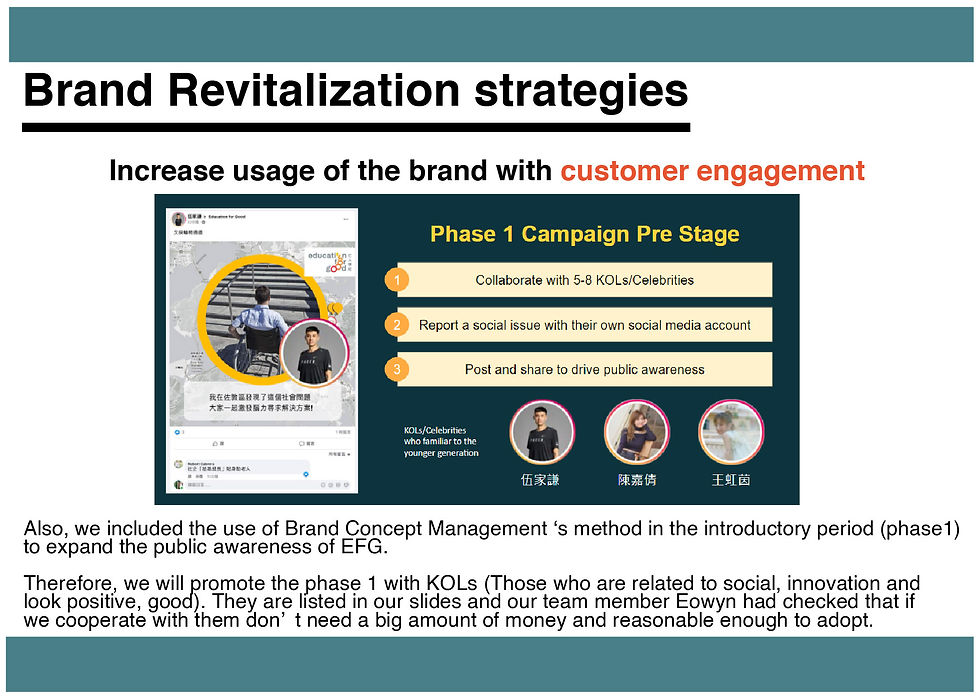
We also include the Customer Engagement
Define: That is how to foster compelling interactions, are about providing broad avenues for exploration and helping people find ways to make parts of their lives more memorable, fulfilling, delightful. (O'Reilly, s.d)
The phase 1 of our campaign reference to the use of interactions to ensure that they can provide questions and discussion about the social problems and also through these activities, they may find they participating in their live more meaningful and increase the connection between them and EFG.
*Source: (Co-creation Project Powerpoint p.90)
Also, we included the use of Brand Concept-Image Management ‘s method in the introductory period (phase1) to allow customers to understand the brand image of EFG. “It is a set of activities designed to establish a brand image and position the marketplace during the period of market entry.” (Park et al., s.d) Therefore, we will promote the phase 1 with KOLs (Those who are related to social, innovation and look positive, good) . They are listed in our slides and our team member Eowyn had checked that if we cooperate with them don’t need a big amount of money and also reasonable.
*Source: (Co-creation Project Powerpoint p.87)
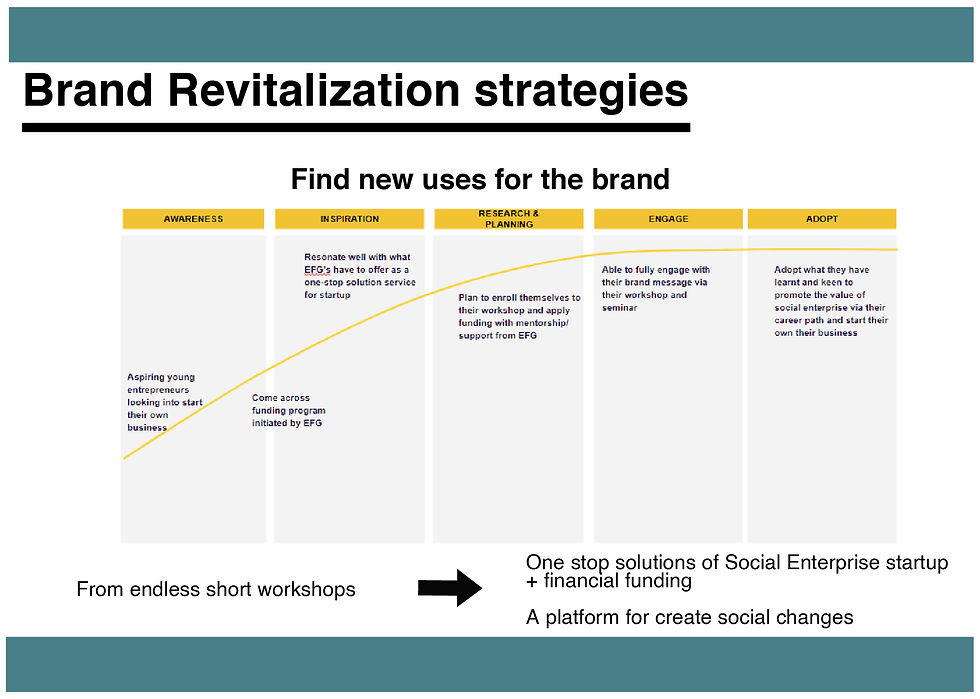
2. Find new uses for the brand
In 10 years, they provide trainings on introducing methods to solve social problems. However, without actual recognized result, it ‘s hard to say their education is successful.
In phase 2, with the aid of SIE Funding, they can promote them as a real practical training institute to the youth and they are really helping them to start a startup instead of just some workshops that look like interest classes.
Those new users in universities are better targeted with this campaign and this can expand their brand awareness in the future.
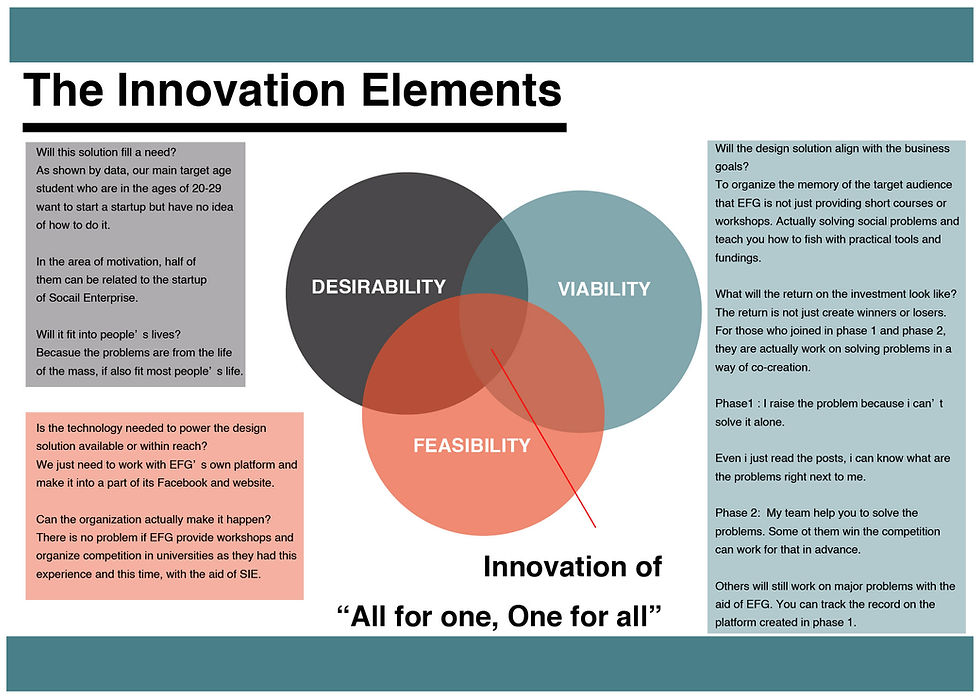
3. Innovation elements for the campaign
*Source: (Cristache, 2021)
Bear in mind that, we study this is not just for design and brand management, so i illustrated the whole picture to show the innovation adopted in this campaign from desirability, viability and feasibility.
With the learning of data-driven research, design of different strategies and the innovative elements, this project helped me to consolidate my knowledge and at the same time know how to manage them to be used in 1 project.
Stage 3: What Now
5. How to think and act differently in future situations
For better understanding, I will divide it into 2 parts.
1. Communication:
As co-creation need the cooperation and participation of members in different areas, so I will make sure the communication is smooth and everything is understandable.
With this project, I learned how to manage the meeting skills though internet and the software like zoom, online platform to generate ideas or even the basic use of whatsapp.
However, I found that not all of us have the same understanding towards the same question when we are working on the projects.
So, what will I do to improve it and reduce the noises?
To require everyone to ask and answer before any presentation, so that we can know each other are having the same understanding towards the same part. This is my fault that I just express the points but didn’t ask again how the part will be presented. Because even we use same lesson notes, everyone will read it differently and that’s the point I missed.
2. Research:
Actually, this part is quite smooth in this project.
But the only problem is I didn’t have enough time to do all the basic research so I will request more people to provide some information for reference to ensure that everyone know the situation of the research and have an understanding on it even that part may not be the main works of each other’s.
Design the visual elements before the setting up of the project. Although I thought we were quite united on this part, we still have room to improve.
For instance, we can start with setting the format of the projects like the basic layout, the fonts, the color, the reference and so on, we can save more time to rearrange the slides, and this will help to save time too.
Conclusion:
To summarize of the future action, I will use this learning' outcomes for starting my own business and apply new job in the management level. Besides, as just 1 project is not enough for me to remember and apply all the techniques, so continuously to study more deeply about branding by self-study in different brands is need.
If there is a cooperation or co-creation project again, i think we will better list out all the requirement separately first so that the common ground is more solid and make sure everyone is actively involved rather than passively receive information. And that’s one of the aim of our course: Learn how to ensure two way communication!
Practise makes perfect!
Reference:
aconsumingblog. (2016) 'Central VS Peripheral Routes to Persuasion.' At: https://aconsumingblog.wordpress.com/2016/12/07/blog-8/ (Accessed 6/4/2022).
Barnlund, D. (1970) 'A transactional model of communication' In: K.K. Sereno & C.D. Mortensen (Eds.) Foundations of communication theory (pp.83-102). New York: Harper.
Cristache, A. (2021) 'The Value of Balancing Desirability, Feasibility, and Viability' At:
(Accessed 6/4/2022).
Fabian,S. (2013) 'Consumer Attitude Formation and Change' At: https://www.slideserve.com/seth/consumer-attitude-formation-and-change (Accessed 6/4/2022).
HARAPPA. (2020) 'The Importance Of A Data-Driven Approach' In: harappa.education
At: https://harappa.education/harappa-diaries/data-driven-approach/ (Accessed 6/4/2022).
Jacobs,G. (2016) 'Media Marketing Management' At: https://slideplayer.com/slide/10424980/ (Accessed 6/4/2022).
O'Reilly. (s.d) 'Customer Engagement' At:
https://www.oreilly.com/library/view/ten-types-of/9781118571392/xhtml/Chapter12.html (Accessed 6/4/2022).
Park,C. et al. ( s.d) 'Strategy Brand Concept-Image Management' At:
https://www.yumpu.com/en/document/read/28447940/strategic-brand-concept-image-management (Accessed 6/4/2022).
Pearson Education, Inc. (2013) 'CHAPTER:13 Managing Brands Over Time' At:
https://slideplayer.com/slide/13829635/ (Accessed 6/4/2022).
Ramaswamy, V. (2011) 'It's about human experiences… and beyond, to co-creation. "Industrial Marketing Management 40(2):195-196.
Traore, M. (2019) 'How to turn your data into actionable insights [Framework]' At: https://www.adviso.ca/en/blog/guides-en/how-to-turn-your-data-into-actionable-insights-framework/ (Accessed 6/4/2022).
UKESSAYS. (2021) ‘Managing Brands with Brand Reinforcement and Revitalisation' At:
https://www.ukessays.com/essays/marketing/what-is-brand-reinforcement-and-revitalisation-marketing-essay.php (Accessed 6/4/2022).


Comments